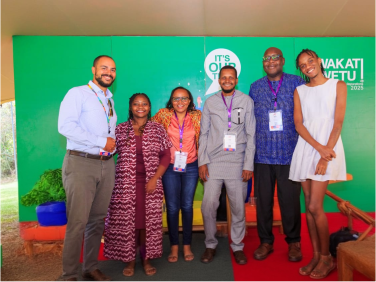
The Collective was born out of the Wakati Wetu Festival (external link), held in Nairobi in October 2025 - a landmark gathering that celebrates the shift of the reparation's movement entering a new phase of strategy, solidarity, and unstoppable momentum. The festival brought together activists, researchers, legal experts, and organizers committed to reimagining a repaired and just future for the continent. During the festival, a dedicated roundtable on Climate Justice and Reparations convened leading African voices across law, policy, grassroots organizing, and research. This conversation marked a turning point. Participants collectively recognized that advancing climate reparations on the continent required more than isolated interventions or one-off convenings. It demanded a sustained, coordinated, and strategic space. From this shared commitment, the African Climate Reparations Collective emerged.
Origins
Why the Collective
Africa is living the consequences of a climate crisis it did not cause. These impacts are not isolated events, they are the continuation of centuries of colonial extraction, racialized exploitation, and externally imposed economic systems that continue today under new forms, including debt-based finance, carbon markets, and extractive “green” transitions.
Despite growing mobilization around climate justice, efforts on climate reparations across the continent have remained fragmented and under-resourced, often sidelined in global policy spaces. At the same time, important political and legal openings are emerging—from loss and damage frameworks to ICJ advisory opinions and African Union’ decade on reparations.
The Collective exists to ensure that these opportunities are not missed, diluted, or captured, but shaped and driven by African priorities.
Our Purpose
The African Climate Reparations Collective works to move climate reparations from the margins to the center of African climate politics. It does so by:
- Coordinating for impact by strengthening coordinated African civil society advocacy and engagement on climate reparations across continental, subregional, and global policy spaces.
- Forging African-led strategies by developing shared political, legal, and policy strategies rooted in African realities.
- Strengthening the evidence base by consolidating evidence, tools, and narratives that support reparative claims.
- Reclaiming the narrative by shifting climate policy debates from technocratic fixes to responsibility, repair, and power.
Our Approach
The Collective operates as an integrated space, bringing together advocacy, research, policy engagement, and movement building, rather than functioning as a loose network.
It is grounded in a set of core principles:
Accountability over charity: climate reparations are about historical responsibility and obligation not aid.
Structural transformation: addressing root causes of harm, including systems of extraction and inequality.
African-led leadership: priorities and strategies defined by African actors and communities.
Intersectional justice: centering those most impacted, including women, youth, Indigenous peoples, afro-descendants and frontline communities.
Grounded knowledge: linking research to lived realities and concrete policy change.
Non-extractive collaboration: ensuring partnerships respect and strengthen African agency.
What We Do
1. Advocacy and Policy Engagement
We coordinate joint advocacy, develop shared positions, and engage with African governments, regional institutions, and global processes to advance climate reparations.
2. Research and Knowledge Infrastructure
We produce and curate African-led research, case studies, and legal analysis grounded in lived experience.
3. Strategic Foresight and Resourcing
We track political, legal, and funding developments related to climate reparations, identify opportunities and risks, and coordinate approaches to resource mobilization.
Founding Members and Roles
The African Climate Reparations Collective operates through a non-hierarchical structure, with founding members leading key areas of work:
Coordination – Patrick Toussaint, African Futures Lab
Partnerships – Hélène Himmer, African Futures Lab
Opportunities – Mary Morrison, Biophilic Conversations
Advocacy – Omar Elmawi, Power Shift Africa
Research – James Gondi, Terra Lex Africa
Strategic Advisor – Erica Njuguna, ANGRY Alliance