May 2026 | Webinar Recording: The African Court Climate Advisory Opinion and the Case for Climate Reparations

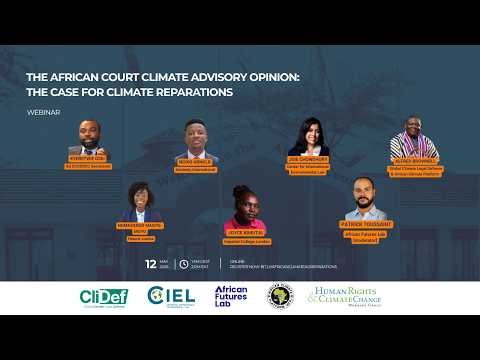
On Tuesday, 12 May 2026, we hosted together with the Center for International Environmental Law (CIEL) (external link), the African Climate Platform (external link) and Climate Legal Defense (external link) in this webinar on The African Court Climate Advisory Opinion and the Case for Climate Reparations. The event took place from 14:00 to 15:30 EAT.

This moderated expert dialogue unpacked the advisory opinion request before the African Court on Human and Peoples’ Rights (external link) and explored its implications for state obligations, corporate accountability, and the right to reparations for climate harm. 

The panelists

In case you missed it

I. Key Messages to Governments

The climate crisis cannot be separated from Africa’s history of colonial extraction and structural economic injustice. African governments should treat climate reparations not as a symbolic or rhetorical issue, but as a matter of legal obligation, political strategy, and continental coordination.

1. Climate reparations are no longer a fringe demand.

  • African Union institutions, civil society, diaspora movements, and multilateral bodies are increasingly recognising reparations as a legitimate framework for justice and accountability.
  • The AU Decade on Reparations and the recent United Nations General Assembly resolution recognising the transatlantic slave trade and slavery as the gravest crime against humanity, and affirming reparations as part of the remedy, signal growing political momentum.

2. African governments should advance a common continental position on climate reparations.

  • Africa contributes less than 4% of cumulative greenhouse gas emissions but remains among the regions most vulnerable to climate harm.
  • Fragmented climate governance weakens African negotiating power internationally.

3. Climate justice and reparations must become central to African climate diplomacy ahead of COP32 in Ethiopia.

  • Reparations should not be treated as separate from adaptation, loss and damage, debt, development, or just transition debates.
  • African states should actively integrate historical responsibility into climate negotiations and legal strategies.


4. African governments have legal and political grounds to pursue reparations from major emitters and fossil fuel corporations.

  • Recent advisory opinions from international courts increasingly affirm duties to prevent harm, regulate private actors, and provide remedies where harm occurs.
  • International law does not limit responsibility simply because multiple actors contributed to climate harm.

5. Governments should support stronger cooperation between science, litigation, and social movements.

  • Attribution science is increasingly capable of linking emissions to specific harms.
  • Litigation strategies and community-led advocacy are helping move reparations from abstract demands into concrete legal and political discussions.

6. African states should ensure meaningful civil society participation in climate governance processes.

  • Current continental climate governance structures often marginalize civil society organisations and broader African Union institutions working on human rights and justice issues, despite their important contributions to climate governance debates.
  • More inclusive participation can strengthen accountability, legitimacy, and coordination across African climate governance processes.
II. Key Messages to the Judges of the African Court on Human and Peoples’ Rights

The African Court has an opportunity to make a historic contribution to international climate jurisprudence by grounding climate obligations within African realities, histories, and legal traditions.

1. The climate crisis in Africa cannot be understood outside the context of colonialism and historical extraction.

  • Colonial land dispossession, extractive economic systems, and environmental degradation continue to shape present-day climate vulnerability across the continent.
  • Historical responsibility is therefore central to understanding contemporary climate harm.


2. The Court has an opportunity to develop an Afrocentric approach to climate justice.

  • Existing advisory opinions have advanced important principles, but gaps remain regarding colonial harms, reparative justice, and African experiences.
  • The African Charter provides a strong normative basis for addressing these issues.

3. Climate harm engages multiple rights protected under the African Charter.

  • Including the rights to life, health, movement, dignity, development, and a satisfactory environment.
  • Climate-induced displacement, food insecurity, and ecological destruction directly affect these rights.

4. Reparations should not be limited to narrow financial compensation.

  • Reparative justice may include restitution, rehabilitation, guarantees of non repetition, structural transformation, and measures addressing ongoing inequality and exclusion.
  • Non-economic harms, including harms to culture, identity, ways of life, and Indigenous knowledge systems, must also be recognised.

5. The burden of proving causation must not become a barrier to justice.

  • Attribution science is evolving rapidly and increasingly demonstrates links between emissions, extreme weather events, and climate harms.
  • Evidentiary standards should remain responsive to the realities faced by vulnerable and marginalized communities.

6. States have obligations not only domestically but also internationally.

  • African states may have duties to pursue international cooperation and seek reparations from those most responsible for climate harm.
  • Climate obligations must be interpreted consistently with principles of equity and common but differentiated responsibilities.

7. The Court has an opportunity to clarify obligations toward future generations.

  • Climate justice requires protection not only for present populations but also for future generations and historically marginalized communities.

III. Key Messages to Civil Society & Potential Litigants

The African Court advisory opinion process demonstrates that African civil society is not waiting for permission to shape international climate law and reparative justice debates.

1. This advisory opinion process itself is already a significant political achievement.

  • Unlike several previous climate advisory opinions initiated by states, this process was driven directly by African civil society organisations.
  • It demonstrates the growing power of coordinated movement-led legal strategies.

2. Litigation should be understood as part of broader political mobilization.

  • Court processes alone will not deliver justice.
  • Strategic litigation is most effective when combined with grassroots organizing, movement building, scientific evidence, and political advocacy.

3. Climate reparations and colonial reparations are deeply interconnected.

  • Climate vulnerability across Africa reflects long histories of extraction, dispossession, and imposed economic dependency.
  • Civil society should continue developing narratives and campaigns that connect these histories clearly and concretely.

4. Science is becoming an increasingly powerful tool for accountability.

  • Attribution science is strengthening the ability to connect emissions with specific climate harms.
  • Communities, advocates, and litigators should continue building relationships with scientists and researchers.

5. Reparations are broader than compensation alone.

  • Demands can include land restoration, debt relief, institutional reform, rehabilitation, guarantees of non repetition, protection of Indigenous knowledge, and community-led adaptation support.

6. Pan-African coordination matters.

  • Fragmentation weakens advocacy and negotiating power.
  • Stronger collaboration across African movements, legal networks, youth organizations, Indigenous groups, and diaspora actors will be essential ahead of COP32 and beyond.


7. Storytelling, memory, culture, and public engagement are political tools.

  • The reparations debate must move beyond elite legal and diplomatic spaces.
  • Artists, youth, feminists, academics, and frontline communities all play a critical role in shaping public understanding and political momentum.